
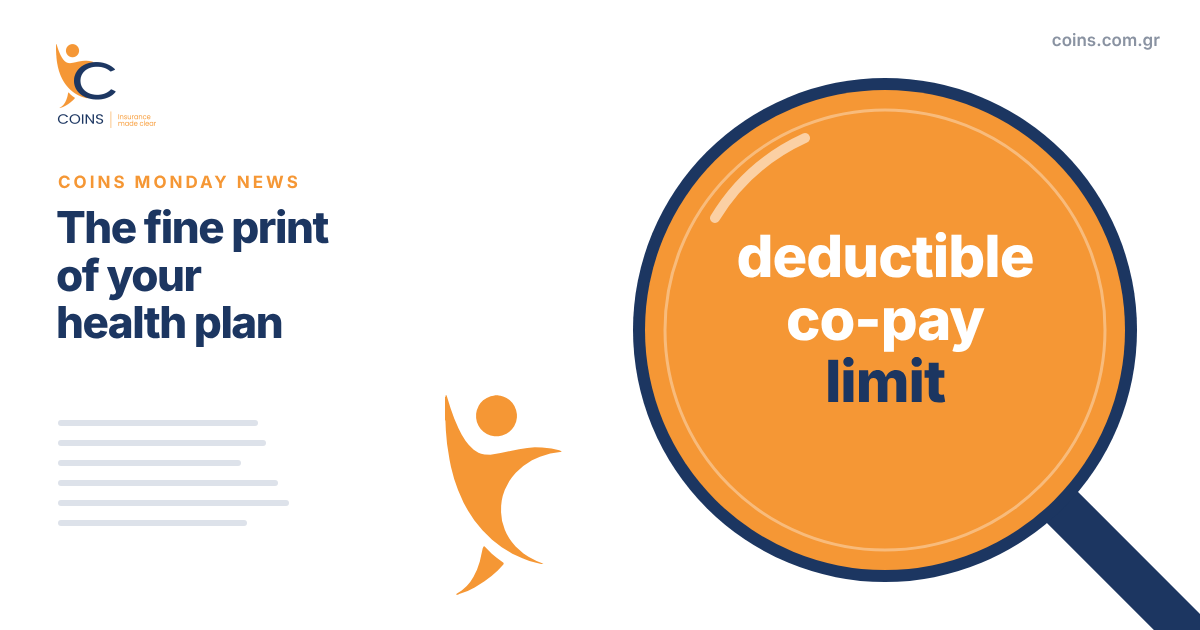
Two policies can cost about the same each year and still leave you with very different bills when you leave hospital. In any health plan, the difference usually comes down to three words. So once you understand them, you know in advance what you pay and what the insurer pays.
1. Deductible: the amount you pay first
The deductible is a fixed amount that stays with you before the insurer starts paying. In general, a higher deductible means a lower premium. That is why it pays to check whether it applies per claim or per year. Also, see whether it drops when another payer covers part of the bill first, such as EOPYY or a group plan from work. Finally, in family plans, check whether it applies to each member separately.
2. Co-payment: a share of every bill
After any deductible, you may also pay a percentage of what is left. For example, that percentage can change depending on the hospital, whether it is in the insurer’s network or not. In addition, check whether your co-payment has a yearly cap.
3. Limit: where cover stops
The limit is the most the insurer will pay, per year, per claim or per type of expense. However, watch the sub-limits too, such as room type or surgeons’ fees. In other words, a large overall limit means little if the sub-limits are low.
Where to find them
You will usually find them in the benefits table and in the policy terms. Read the two together, because the table shows amounts and percentages, while the terms explain when and how they apply. That way, you can ask about anything unclear before you sign, not on the day you go into hospital.
Did you know…
For non-life insurance products, which include many standalone health plans, the Insurance Product Information Document must fit on two A4 pages (three by exception). In addition, the main exclusions go in a dedicated section headed “Are there any restrictions on cover?”, with an orange exclamation mark next to each one. (Articles 3 and 6(1)(f), Commission Implementing Regulation (EU) 2017/1469)
So, do you know the deductible on your own health plan?